The Moment Prahok Stopped Being Invisible
If you’ve been paying attention to professional kitchens over the past two years, you’ve noticed something shifted. Chefs who built their names on French technique and Italian precision started talking about prahok the way they once discussed aged balsamic or Colatura di Alici. This wasn’t a gradual creep. It happened fast enough that you could almost pinpoint when the conversation changed.
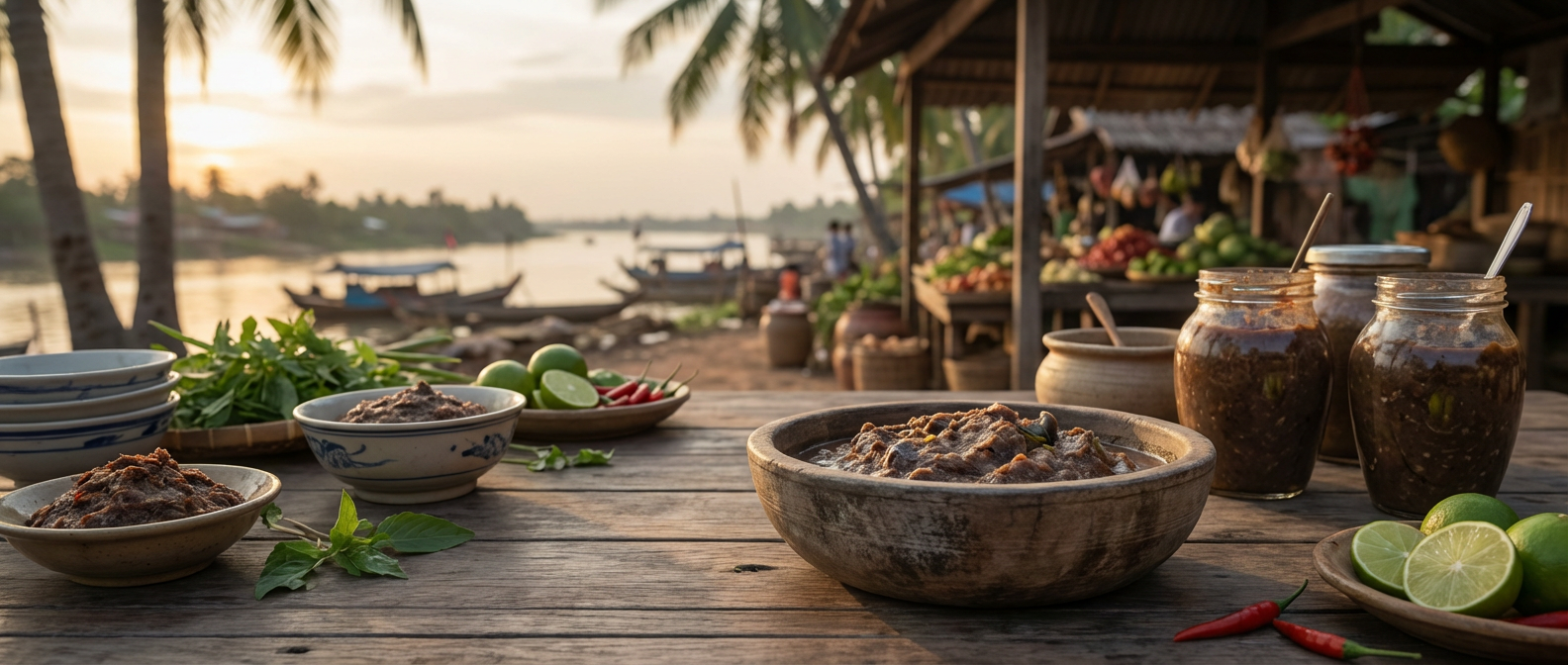
Both the National Restaurant Association What’s Hot 2026 culinary forecast and Eater 2026 food trend predictions identified Cambodian cuisine as one of the top five global food movements worth watching. These forecasts don’t just reflect what’s trendy. They reflect what smart operators believe will sustain their business and their menus.
The rise of prahok within that larger wave of Cambodian cuisine tells us something about how professional cooks think now. They’re looking for foundational flavors that do the heavy lifting, ingredients packed with enough concentrated umami and complexity to change the entire architecture of a dish. Prahok delivers that in spades.
The Science Behind Why Prahok Hits Harder Than Fish Sauce
Let me be clear about something from the start: fish sauce and prahok are not interchangeable, despite what casual cooks sometimes assume. They’re both fermented, both funky, and both deeply rooted in Southeast Asian cooking. But the biochemistry tells a different story.
Prahok contains measurably higher concentrations of histamine and free amino acids than standard fish sauce. More importantly, aged varieties reach glutamate levels around 1,200 milligrams per 100 grams. That puts it in the same neighborhood as aged Parmigiano-Reggiano and properly fermented miso. You’re not using it as a background note. You’re using it as a fundamental building block.
The difference comes down to production. Fish sauce is made from anchovies and salt, fermented in large quantities and filtered for clarity. Prahok is made from mud fish, left whole or in large pieces, fermented more slowly and less intensively. The result is a paste, not a liquid. That paste contains intact fish flesh that keeps breaking down into amino acids over months or years. The longer it sits, the more glutamate accumulates.
In practical terms, a tablespoon of prahok in a pot of broth does something that three tablespoons of fish sauce cannot. It builds a savory, almost meaty foundation that feels engineered at the molecular level to make everything taste more like itself. For a professional cook working with tight margins, that efficiency matters.
Following the Money: Where Prahok Is Actually Coming From
Trends in food don’t move randomly. They move where supply and visibility intersect with credibility. In the case of prahok, the credibility came from one place specifically: Nite Yun of Nyum Bai in Oakland.
Yun earned a James Beard Award nomination while running a restaurant that centers Cambodian food without apology or compromise. She’s also been cited in over a dozen major food publications between 2024 and 2026 as the primary force bringing prahok into mainstream American professional kitchens. When a Michelin reviewer writes about prahok, they’re writing about what they learned at Nyum Bai. When a chef in New York sources it, they’re often following the trail that Yun blazed.
The import data is worth looking at. US Census Bureau trade figures show that imports of Southeast Asian fermented fish and shrimp pastes grew 22 percent between 2023 and 2025. California, Texas, and Georgia account for 74 percent of that volume. Those aren’t random numbers. California has Oakland. Texas has Houston with its enormous Cambodian and Vietnamese populations. Georgia has Atlanta’s growing Southeast Asian culinary scene.
The supply chain is still small enough that knowing where to source quality prahok requires real effort. You can’t walk into most mainstream grocery stores and find it. That scarcity creates a kind of gatekeeping effect. The cooks who have access tend to be the ones paying attention, reading restaurant publications, following the real conversations happening in professional kitchens.
Home Cooks Are Catching Up Faster Than Anyone Expected
Here’s what surprised me most about this trend: it’s not just chefs anymore. A 2025 Tasting Table consumer survey found that 38 percent of home cooks under 35 had purchased at least one fermented Asian condiment beyond the standard soy sauce and fish sauce in the previous six months. In 2020, that number was 11 percent. That’s not incremental growth. That’s a real shift in what home cooks consider essential.
The younger cohort is also more likely to understand prahok as a value proposition. A jar of high-quality prahok costs roughly the same as a good bottle of fish sauce, maybe slightly more. But because it’s so concentrated in flavor, you use less of it. A single tablespoon can carry an entire pot of soup or braise. On a practical, dollar-per-use basis, it’s actually cheaper than relying on fish sauce.
This matters because it means prahok isn’t going to disappear when the trend cycles. It’s going to stay because people will realize it actually works better and delivers better value. That’s how ingredients become permanent fixtures instead of passing fads.
What This Tells Us About the Future of Fermented Fish
The prahok moment reveals something important about where professional and home cooking are heading. We’re moving past the era where fermented condiments were curiosities from other cuisines. They’re becoming understood as technical ingredients with specific applications and measurable advantages.
The next wave will be cooks getting more specific about which fermented paste serves which purpose. Prahok for depth and body. Fish sauce for brightness and penetration. Shrimp paste for a different kind of funky umami. Miso for earthiness. Each one has its place. Each one solves a different problem.
The barrier to entry is lower than it’s ever been. If you’re curious about prahok, you can order it online, find recipes built around it, and taste it at restaurants now confident enough to feature it prominently. A year ago, that felt genuinely difficult. Now it doesn’t.
Have you cooked with prahok yet? If not, I’d genuinely like to hear what’s holding you back. Is it sourcing? Uncertainty about how to use it? Or just the fact that you haven’t encountered it yet? The conversation about this ingredient is still early enough that there’s room for real exploration. Drop a comment if you’ve got questions or if you’ve already experimented with it.