The Math That Doesn’t Add Up
Let me be direct: the restaurant industry is broken, and it’s not broken because chefs can’t cook or servers can’t serve. It’s broken because the fundamental economics stopped making sense somewhere around 2015, and nobody’s found a sustainable fix yet. The National Restaurant Association reports that the US restaurant industry pulled in 1.1 trillion dollars in 2025, which sounds enormous until you understand what that actually translates to on the ground level. Most restaurants operate on profit margins between 3 and 9 percent. That’s not a typo. A single bad weekend, a surprise spike in food costs, or a kitchen fire can obliterate an entire year’s profit.
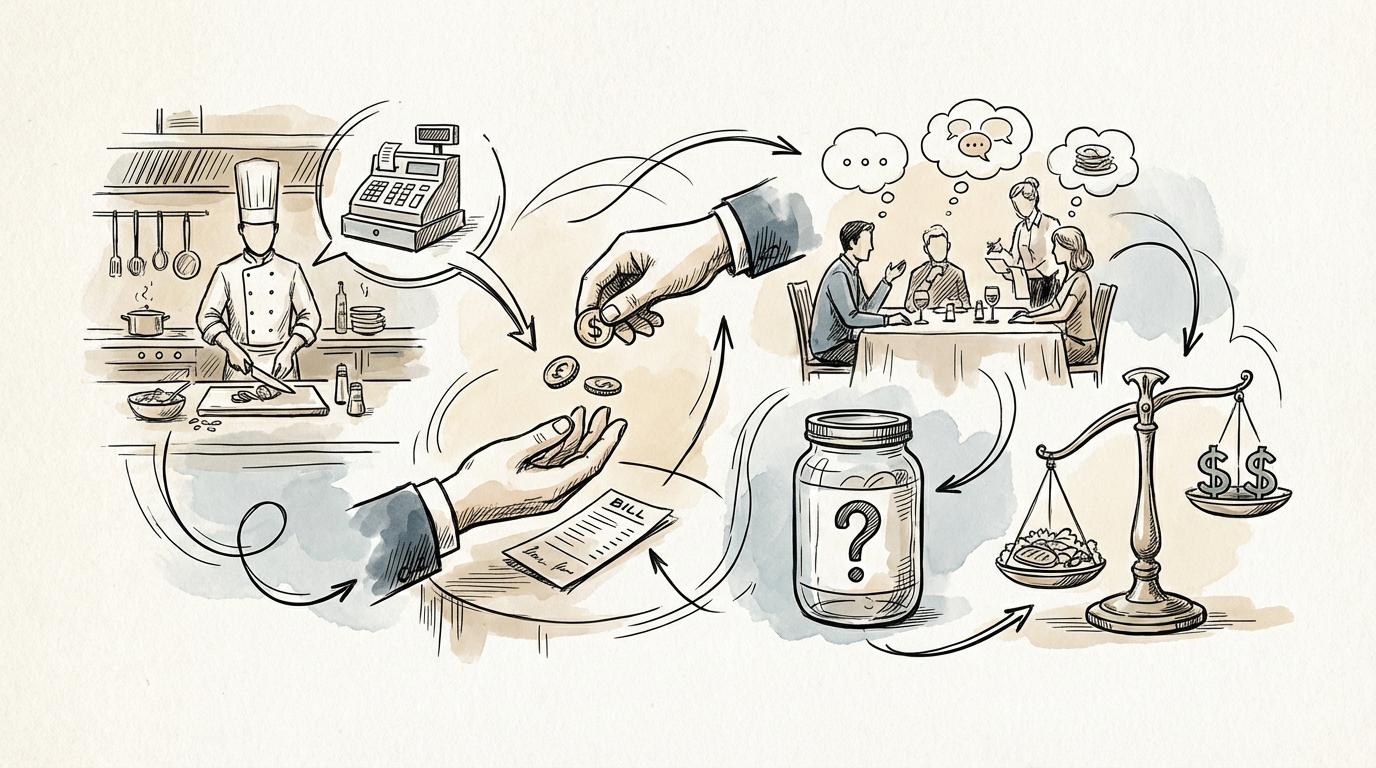
I’ve worked in enough restaurant kitchens to know exactly where money disappears. Labor costs run 28 to 35 percent of revenue for full-service restaurants. Rent for decent real estate in any major city has become absurd. A mid-level urban restaurant might pay 8 to 12 percent of gross revenue just for the space. Then add utilities, insurance, equipment maintenance, waste disposal, and the constant need to replace worn-out smallwares. By the time you’ve paid your suppliers and covered your overhead, the margin left for actual profit is paper-thin. This is why a restaurant that seems perpetually busy can still close suddenly. You’re not seeing the full picture from your table.
The Tipping Spiral Nobody Wanted
Here’s where things get uncomfortable, and I’m going to say what most restaurant industry people won’t: tipping culture in America has become a psychological burden on both sides of the equation. Seventy-five percent of customers now report feeling pressured when the card reader slides across the counter with suggested tip amounts ranging from 18 to 25 percent. That’s not gratitude anymore. That’s coercion dressed up in politeness. I’ve worked shifts where I made decent money from tips, and shifts where I made nothing. The unpredictability created stress that affected the quality of service I could deliver, because I was anxious about money instead of focused on the table.
The real problem is that restaurants have offloaded wage responsibility onto customers while simultaneously facing wage pressures that demand higher base pay. A server in New York or San Francisco needs to make enough money to afford rent in that city, but restaurants can’t sustainably raise base wages when margins sit at single digits. So the industry invented a workaround: expand tipping culture into every interaction. Baristas, bakery workers, grab-and-go counters. It’s metastasized into something that makes nobody happy. Customers feel nickeled and dimed. Workers still don’t make stable money. Owners can’t profitably raise wages. Everyone loses except the tip-shuffling algorithms.
Service-Included Pricing and the Honest Conversation
The tide is shifting in major coastal cities, and frankly, it’s about time. More restaurants are experimenting with service-included pricing models, where gratuity is built into menu prices and paid directly to staff instead of collected at checkout. This sounds simple, but it’s actually a radical restructuring of how restaurants operate. At its best, it’s honest. You see the full price. Staff gets reliable income. No psychological warfare at the payment terminal. Eater food culture has covered this shift extensively, and the data shows customers respond well when they understand the model upfront.
But here’s the catch: it requires restaurants to be transparent about their margins, and it requires consumers to accept higher menu prices. Both things create friction. Restaurants worry that sticker shock will drive customers away. Diners who’ve spent years conditioning themselves to ignore menu prices and add tip at the end suddenly see the true cost of dining out, and it’s jarring. Yet this is actually how most of the world operates outside America. You pay the price on the menu. Staff gets a living wage from the restaurant. Everyone understands the transaction. It’s not perfect, but it’s honest, and honesty is in short supply in this industry right now.
The Delivery Platform Squeeze and Ghost Kitchen Collapse
Food delivery platforms have systematically gutted restaurant economics in ways that most casual diners don’t fully appreciate. Third-party aggregators like DoorDash, Uber Eats, and Grubhub take between 25 and 35 percent commission on each order. That’s not a minor operational expense. On a typical $40 entree order, you’re losing 10 to 14 dollars before your food costs are even factored in. For thin-margin restaurants, that’s the difference between profit and loss on that transaction. Restaurants accepted these terms because they were desperate for incremental revenue during the pandemic. Now, five years later, they’re trapped. They can’t remove themselves from the platforms without losing visibility, but the commissions are unsustainable.
The ghost kitchen boom that exploded in 2020 and 2021 was supposed to solve this. Low-overhead kitchens with no front-of-house, no dining room, pure delivery focus. By 2025, most of those operations have either failed or consolidated. Why? Because the delivery economics never actually changed. You still had to pay ruinous commissions. You still had to deliver food that degraded in quality during transport. You had to compete with thousands of other ghost kitchens. The National Restaurant Association has watched this space carefully, and the data shows that the ghost kitchen concept works only for a narrow subset of high-volume, low-complexity operations. For everyone else, it was a dead end. Restaurants learned that streaming through third-party platforms doesn’t replace the real business of feeding people in your own space.
What This Means for You as a Customer
So where does this leave you when you’re deciding where to eat? Honestly, it’s complicated. Supporting restaurants matters, but not blindly. Visit places where you can see care in execution, where the owner or head chef is actually present and invested. These places are fighting the numbers every single day. They’ve chosen to stay independent when consolidation would be easier. Ask questions about service-included pricing if you see it. Understand that a restaurant charging what seems like high prices might simply be practicing honesty about their costs. Avoid the places that are just playing the efficiency game, ordering from Sysco, reheating, and praying.
Tip appropriately when you encounter actual service that’s thoughtful and skilled. Don’t tip the iPad screen at a grab-and-go counter just because a prompt appeared. Vote with your money for the business models that make sense to you. If you prefer transparency, patronize restaurants using service-included pricing. If you want the traditional tipping model, that’s fine too, but go in with eyes open about what you’re supporting. Your choices as a customer do shape where this industry goes, even when it doesn’t feel that way.
What’s your breaking point? Where do you draw the line between supporting a restaurant and accepting unsustainable customer economics? Drop your thoughts in the comments. I’m genuinely curious how diners are thinking about this moment in food culture.