Why Restaurants Are Suddenly Making a Big Deal About What They Cook With
Walk into a restaurant in 2026 and you’ll notice something that would have been invisible five years ago: oil declarations. Some places now advertise that they use butter and tallow instead of vegetable oil. Others have added disclaimers about their cooking fats to the menu itself. This isn’t marketing theatre. At least 14 U.S. states have already introduced or are actively considering legislation that would require restaurants to disclose which cooking oils they use, according to tracking by the National Conference of State Legislatures. What started as a fringe nutritional conversation has become a regulatory issue.
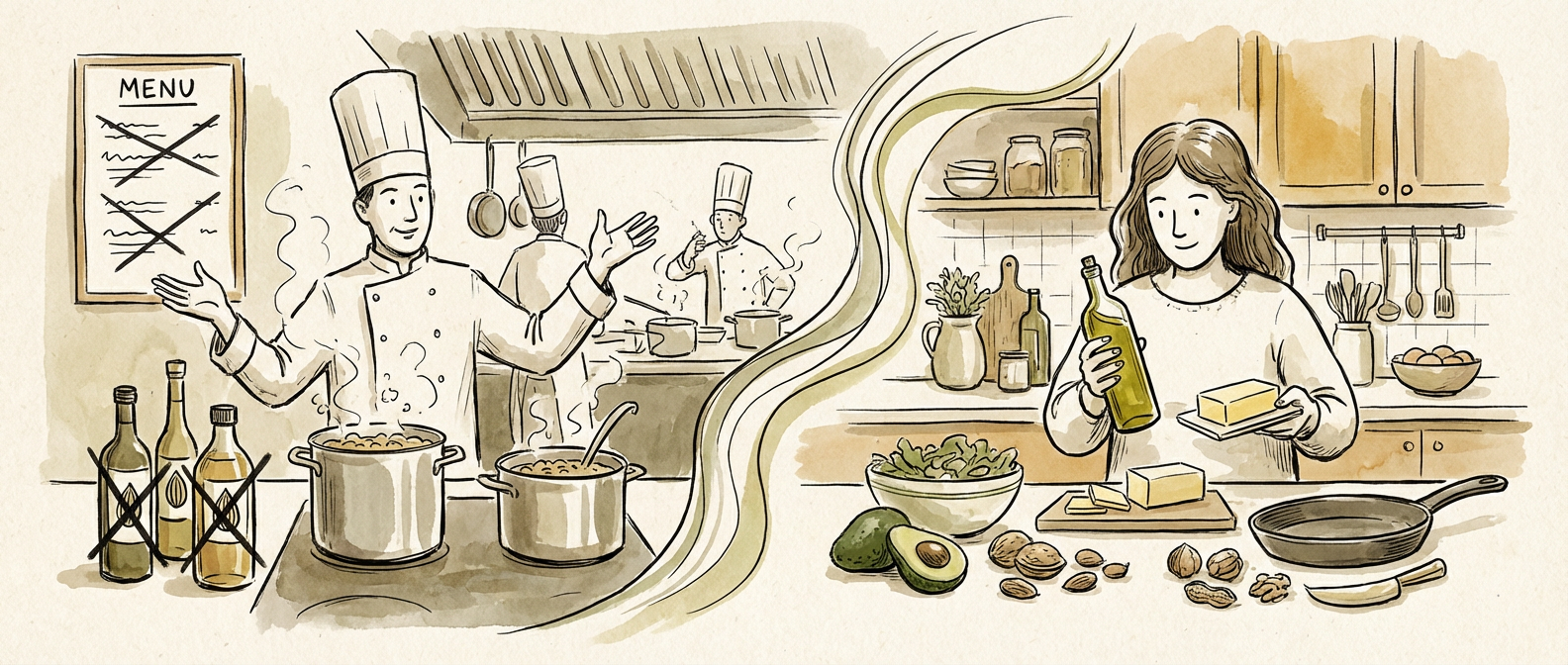
The shift makes sense from a business perspective. Yelp searches for “seed oil free restaurants” jumped 312% between January 2024 and December 2025, according to their trend report. People are actively seeking out establishments based on cooking fat alone. The market has spoken loudly enough that even mid-tier restaurants are adjusting their supply chains. But here’s what matters: most home cooks don’t need to panic, and most of the online debate around seed oils misses the actual point entirely.
The Science Doesn’t Support the Hysteria You’ve Seen Online
The internet’s relationship with seed oils has become almost religious. You’ve probably seen the claims: seed oils cause inflammation, destroy your health, and are basically poison. Social media has transformed these talking points into absolute certainty. Then a 2025 meta-analysis published in The Lancet reviewed 62 different studies and found no conclusive causal link between linoleic acid, which is abundant in seed oils, and systemic inflammation in healthy adults. Let me translate that: the viral claims don’t hold up under rigorous examination.
The American Heart Association updated their dietary guidelines in 2025 and reaffirmed that replacing saturated fats with polyunsaturated fats, which are exactly what you find in many seed oils, reduces cardiovascular disease risk by approximately 30%. This doesn’t mean seed oils are magical. It means they’re not the enemy that social media made them out to be. For most people eating a reasonably balanced diet with adequate fiber and movement in their day, the choice between canola oil and tallow isn’t going to fundamentally reshape their health trajectory.
What’s Actually Worth Buying for Your Home Kitchen
Here’s where I diverge from the purists: the right cooking fat for your home depends on what you’re actually cooking and your budget. I’ve tested this extensively. For high-heat applications like searing meat or wok cooking, refined avocado oil or ghee are objectively better than refined canola oil. They have higher smoke points, period. For that same searing application, though, a $4 bottle of refined vegetable oil works perfectly fine if you’re watching your budget. Neither choice is going to harm you.
Where I do see real value in switching fats is flavor and cooking performance, not health salvation. Tallow and lard are experiencing genuine commercial growth, with brands reporting 180% year-over-year sales increases on platforms like Amazon in 2025. I’ve cooked with both extensively. Grass-fed tallow makes extraordinary beef gravy and roasted potatoes. Leaf lard produces pie crust with a texture that’s genuinely difficult to achieve with any plant-based oil. These aren’t health claims. These are technical cooking advantages that experienced cooks have known for decades.
If you already have money in your food budget and you care about cooking quality, spending the extra $8 on quality tallow is worth it. You’ll use less of it because it’s more flavorful, and your results will be technically superior. But if you’re choosing between regular oil and tallow because you’ve been convinced that one is poison and the other is medicine, you’ve been sold a narrative that doesn’t hold up. The American Heart Association Dietary Fats Advisory is worth reading if you want the actual science without the Instagram hype.
Your Real Decision: Performance, Flavor, or Price
I make my cooking fat choices based on three variables. First is the cooking method. High-heat searing? I want something with a high smoke point and neutral flavor. Low-temperature sautéing for aromatics? Butter all day. Making pastry? This is where fat choice genuinely matters technically. Second is the ingredient cost at my current supplier. Third is what I’m actually trying to accomplish flavor-wise.
None of those variables includes a moral panic about inflammation. That’s the honest truth that won’t go viral on TikTok. If you’re spending 90% of your time worrying about whether your oil is causing chronic disease while eating processed foods and not sleeping enough, you’ve missed the actual levers that control your health. If you’re genuinely interested in cooking better food, then the fat conversation shifts entirely. Suddenly it’s about whether your potatoes taste better roasted in tallow versus olive oil, and that’s a conversation worth having.
What the restaurant menu legislation actually tells us is valuable: transparency is good. Knowing what you’re eating matters. But the fact that restaurants are now marketing their cooking fats doesn’t mean you need to completely overhaul your pantry at home. Check out the Yelp 2025 Food Trends Report and you’ll see this is still very much a trend rather than a settled question. Buy the fat that makes sense for your cooking, your budget, and your palate. Then stop thinking about it and focus on techniques that actually matter: knife skills, heat control, seasoning. Those are the things that separate decent cooks from excellent ones.
What This Shift Actually Means for How You Cook
The real takeaway from restaurants changing their oils is that consumer awareness is rising around ingredient quality generally. That’s entirely positive. The byproduct, unfortunately, is that a legitimate conversation about food quality has gotten tangled up with misinformation. Your job as a home cook is to cut through that noise.
Use what works for your situation. If you can source quality fat and you see technical advantages in your cooking, invest in it. If your budget is tight and your food tastes good, don’t let the panic convince you that you’re poisoning yourself. The restaurants changing their menus aren’t necessarily making better food than the ones still using refined vegetable oil. They’re responding to what their customers are asking for. You get to make that same decision independently, without the social media pressure attached.